Good-bye, Yellowstone! Hello, Thermopolis!
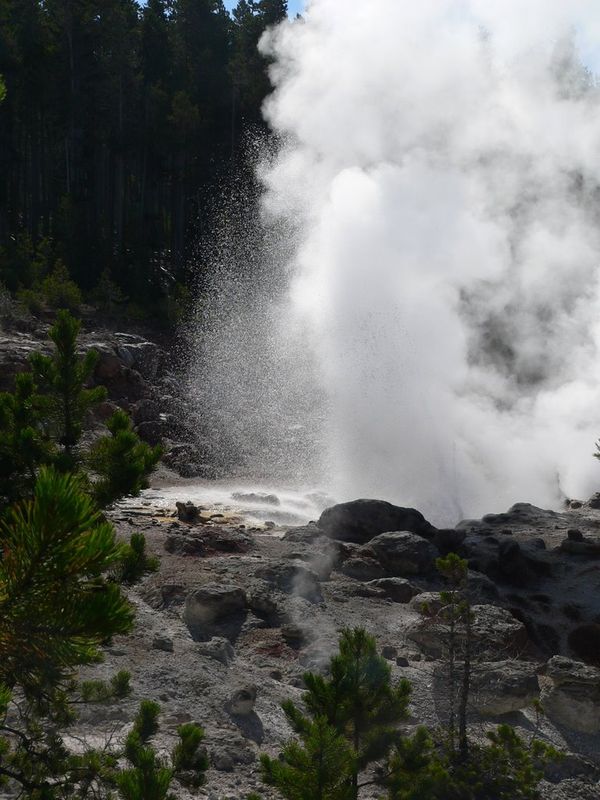
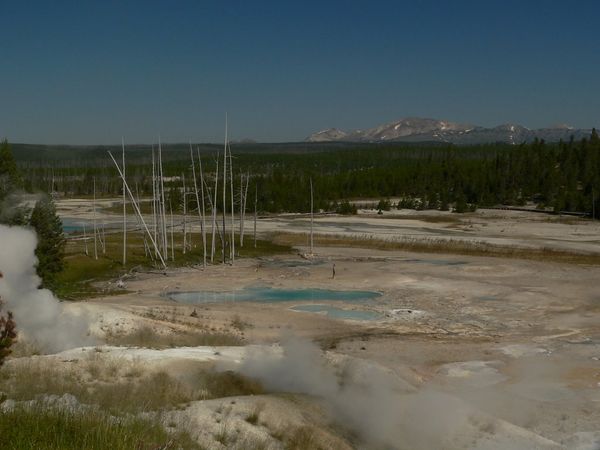
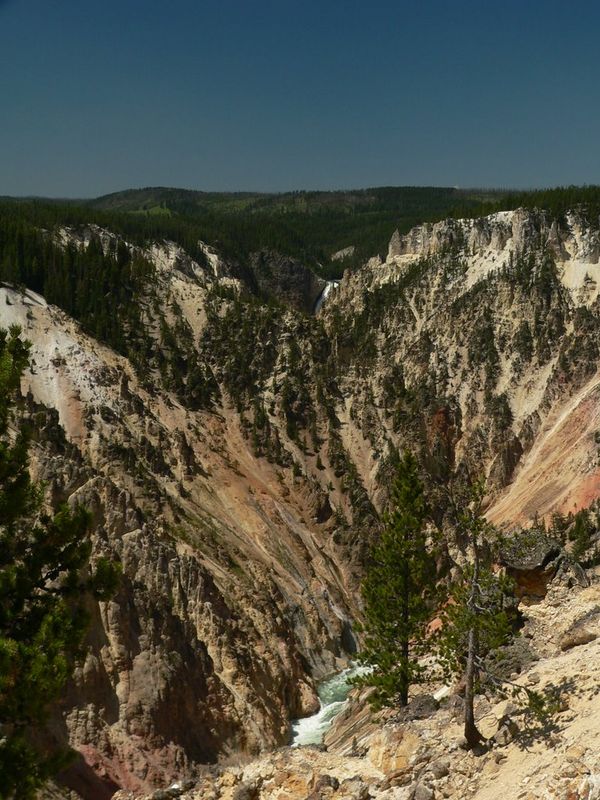
We set a new Manneschmidt record for an early take down--we were out of the site by 8:45--well, it's early compared to the embarassing 10:30 or 11:00 which has been our norm. We drove to Norris Geyser Basin to see Steamboat, the largest geyser in the park and possibly the world. When it has a major eruption, it shoots up 300-400 ft. It was doing its normal performance of only 10-30 ft. blasts. The eruption frequency is very erratic with it's last eruption in May of 2005. We did a short walk around the Norris Geyser Basin area, and the day held promise of being another very hot one. We proceded to see the Grand Canyon of the Yellowstone and the falls. Interesting to think about the fires of 1988 crossing this canyon, but they did.
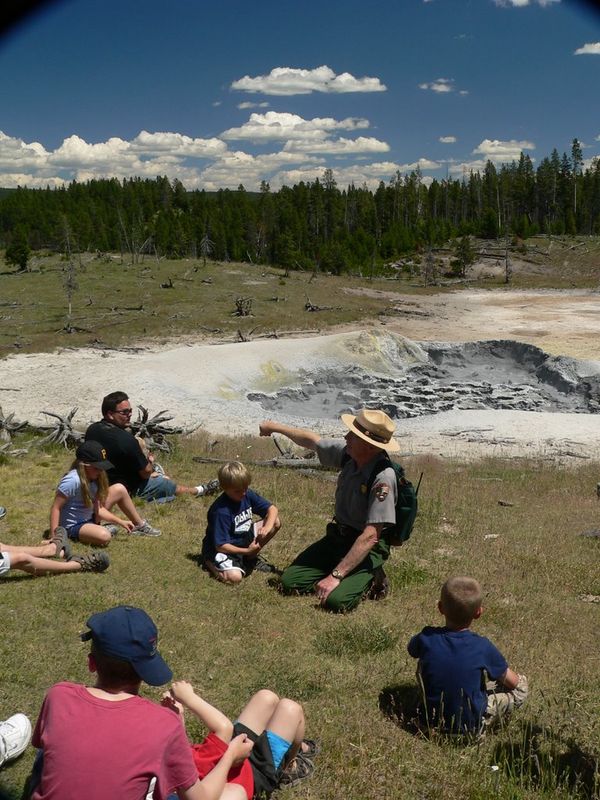
We hurried to make the last ranger led hike, at 1 p.m. at Mud Volcano, snacking in the car as we went. Mary was "over this vacation" and chose to sit in the hot car and play cards or some such thing. Ellen and Ward also decided to stay with her because they thought it was too hot to hike in the sun. But the rest of us intrepid adventurers had the best ranger led hike yet. The leader was a science teacher/park ranger from Washington state who was in his 34th season at Yellowstone. He had a lifetime of stories and a masterful style of relating them to make the walk interesting. He took us off trail up over a piney hill and onto what appeared to be a thermal area. He had two people stomp the ground in unison, and the rest of us all felt the vibration in our feet indicating we were standing on a hollow crust--eerie. Possiby his most intriguing story was when in 1974 he heard some explosion like noises and hurried to see what was going on. He found a hole in the ground opening up and spewing hot mud, coating nearby trees. He raced back for camera, tape recorder, and a rain slicker for protection. He recorded what he saw and heard and showed it to other park officials who wouldn't have believed such a find without this evidence. He and other rangers involved in the early findings of this mud pot decided to call it "Big Gumper." The geologists said that was a ridiculous name and that it should not be called this, but the rangers said that they found it and should be able to name it. The geologists said that the name would never be accepted. Later, National Geographic did a story on the changing face of Yellowstone and included the new mudpot. Their article referred to it as "Big Gumper" which cemented the name in history. He told us this story as we were on a hilltop looking down on the "Big Gumper." He has been watching it over 32 years, and while no longer spewing way up in the air, it is a huge, growing (in diameter) boiling mud pit that must be 40 ft. across. This ranger told bear stories, buffalo stories, dog/scalding stories, etc., all very interesting. I asked him to autograph my map as the discoverer of the Big Gumper which may one day have an offficial name plate if it is ever on a real trail. (addendum--Running this ranger's name, Harlan Kredit, on google revealed that he was one of only five inductees for spring 2006 into the National Teacher Hall of Fame--so somebody else agreed with us that he was an exceptional teacher!)
We stopped by Fishing Bridge Visitor Center which is by Yellowstone Lake. It has a sandy beach out back of it and there were people swimming. The ranger said the water temperature was in the 50's, the warmest it ever gets. Although there are some thermal areas in the lake, they just don't do enough to counteract extended winters with lengthy periods of negative 40 degrees.
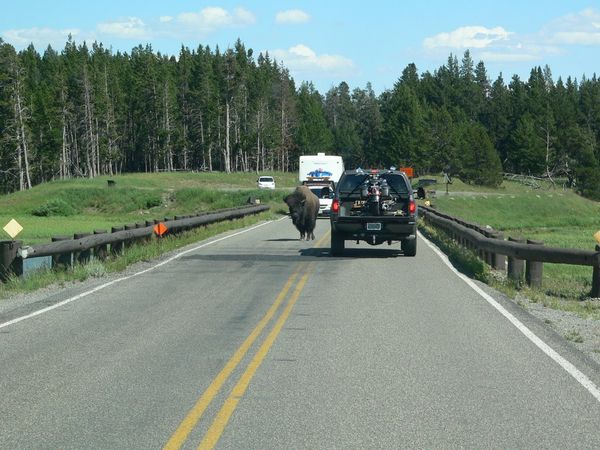
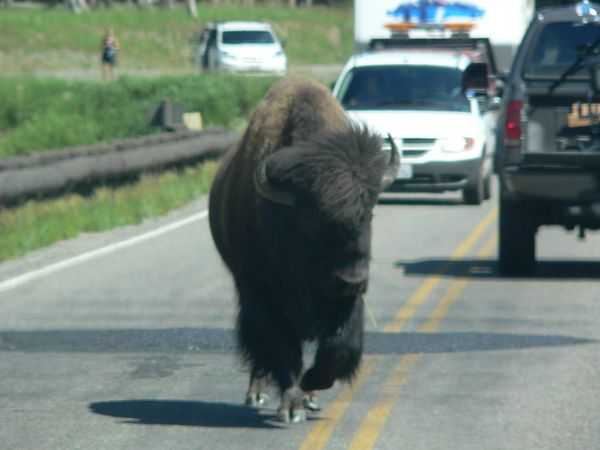
Eric's note: On the drive past the lake toward the East entrance to Yellowstone, we came to a bridge with a buffalo on it. The buffalo had traffic stopped in both directions, but the buffalo wasn't ready to get out of the way. Their eye sight is not very good and is one of the reasons that if you are still, you are pretty safe. But at the same time, this buffalo couldn't determine whether he was blocked in or not. The buffalo was coming in our direction with one vehicle between us and the animal. The vehicle coming from the other direction was blocking the buffalo's return, or so it thought. After several moments of pacing, the animal finally made a short dash past the truck in front of us and then slowed again to decide how to pass us. Unfortunately, the white truck coming in the other direction, coming from behind the buffalo decided to start forward. This didn't make the buffalo feel he had much freedom and I was afraid he might become a problem. I put my hand out of the window gestapo style telling the other vehicle to stop, which it did. The buffalo finally meandered past my window and on down the road. It chose to stay in the center of the road even though at this point, it could have gotten off the road. Anyway, it was past us and on we went. I would not have wanted to tangle with a buffalo even in a 15 passenger van. It is my understanding that a buffalo (even only one) is quite capable of overturning our van. I did talk with somebody whose friend was in standing traffic next to a buffalo. Someone in his vehicle dared him to reach out and touch the buffalo, which he did. The buffalo kicked the side of the van which shook the van violently and left a large expensive gouge in the side. I would have liked to have heard the explanation he gave to his insurance company.
Of course, I would never touch a buffalo, well not again anyway. But that is another story from waaaay back. I was much younger then and attribute it to the "foolishness of youth" which doesn't afflict me quite as much anymore.
Driving to Thermopolis, the landscape reminded me (Margaret) of Venus. The temperature had something to do with that as well. Even though it did not seem terribly humid, it did seem terribly hot. When we ate at the Subway, the servers there said it had been 109 degrees in the shade that afternoon. The Subway people extended real small town hospitality to us. After dinner and camper set up, we took a swim in the hot pool until almost 10:00. It was wonderfully comfortable because the air had cooled and there was a nice breeze. We were awakened in the middle of the night by a train lumbering through. The track is just the other side of the pool.
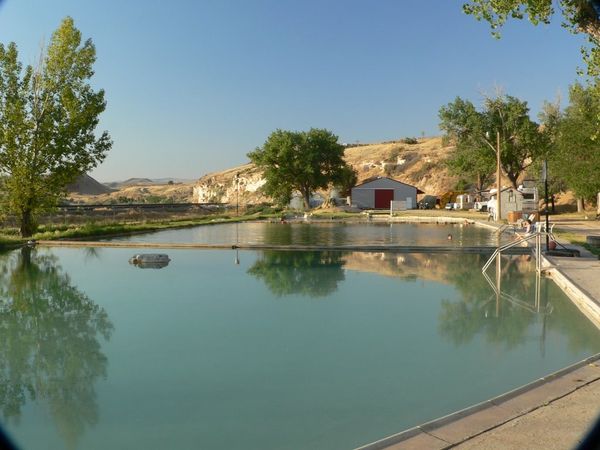
Eric's note: Thermopolis boasts having the biggest hot spring in the world. It produces 1.37 million gallons per 24 hours. That's about 950 gallons per minute. That feeds several spas and pools throughout the city. For those who wonder how hot the water is, it comes out at about 130°F at this location, spills into a cooling pool where no one swims, then into another at about 100°F for those who like it hot, and is at about 90°F in the first pool closest in the picture. This is also where most people spent their time.
- Previous: Laundry and souvenir shopping
- Next: Thermopolis to Custer